|
|
|
|  |
 |
|
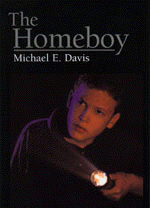
Here's a link to a young Romanian artist whose work I particularly enjoy. | WHAT I'VE LEARNED (or think I've learned) Let me start by saying that I do not feel at all qualfied to tell anyone "how to write". What I will try to share here is what I think I've learned so far. I'll list some books that I've read and could recommend, and finally, I'll offer some links to web sites that I've found particularly helpful and, or interesting. As for the craft of writing, and I do believe it's a craft as opposed to either an art or a science, it seems to be quite frustrating for some writers, if I am to believe many of the books I've read. I can honestly say that for myself, so far, there has been no such thing as "writer's block", or anything that I would describe as close to that condition. There are days when the writing goes more smoothly than others. Days when my first draft is nearly my last, and other days when, even as I write, I know that many rewrites lie ahead of me. A brief word about why I think writing is a craft. I don't think anyone is born with language. We are taught to speak, to write, and to draw pictures. Even the use of words in speaking is a craft, in the sense of learning how to use words to be persuasive, or forceful. We use language to get what we need, and want in life. To put words to paper to tell a story, and to do so in a way that readers will find enjoyable, requires knowing what you personally look for in a story that you are reading. Each of us looks for different elements of writing when we read. Some people enjoy long expositions that create vivid images in their minds. Others appreciate fast moving, hard hitting dialogue to move the story along. I think that as a writer you will probably find yourself writing in a style that you personally enjoy in the work of other authors. Okay, back to writer's block. I've begun to count myself among the more fortunate, given the fact that I am seldom at a loss for words. I don't know whether to attribute that to my Irish heritage, good fortune, or that my mind is open to the idea of putting down any words that come to mind, without restraining them by some preconceived idea of what the story should be. In the early days of trying to write, I attended a number of readings, and seminars given by The Washington Center for the Book at the Seattle Library, as well as readings at the Elliot Bay Book Store in Pioneer Square. I've had the pleasure of listening to such authors as James Lee Burke, Colleen McCulough, Robert Butler, and Margaret Chittenden, to name a few. What I learned from each of them is that there is no one approach to writing a book. Each of them is as unique in their approach as they are as individuals. Like many authors I was probably looking for some "formula" on how to write a story. I think that is typical of people living in the U.S. We want quick answers and short-cuts to success. There isn't one. It takes time, patience, and perserverance. When I first heard authors talk about spending two to five years on a novel, I scoffed. I've always been able to work fast, and had no doubt that I could dash off a novel in much less time than that. After my first couple of "on-the-job-training" efforts, I began working on The Homeboy in 1996. I started writing out ideas in a notebook. Then I sat down at the computer and wrote the first draft. Then I began rewriting, and rewriting. In all, I think I rewrote this story no less than eight times. I thought I was done in 1999, then I read a book by David Michael Kaplan, titled "Revision-A Creative Approach to Writing and Rewriting Fiction". I went back for yet another rewrite. Before I was done, my novel had gone from somewhere int he neighborhood of 130,000 words to just over 90,000. Almost four years had passed since I had started scribbling those first ideas in my notebook. I also came to understand something Colleen McCullough said. She told us she never reads one of her books once it's been published because she'll want to start rewriting it again. I know the feeling. The other thing I've discoverd over the years, and this may just be the way my mind works, is that I seldom adopt just one approach to doing anything, and that includes writing. I tend to find as many sources, hopefully authoritative ones, as I can and study them all, looking for a single thread that runs through the lessons. Since I enjoy golf, I'll give you a golf analogy. Every professional golfer will have their own tricks on how to get a great drive off the tee, or how to sink that critical putt, but as you read through the advice, you find some constants. Always grip the club the same way. Always use the same approach to the ball. There are a number of basics that they all follow. I tried to find that in the many books, readings, discussions with authors, and writer's workshops I attended. What are the basics about plot, dialogue, settings, and the so-called arc of the story. After that, I let myself wander a bit to find my own approach to constructing and telling a story, but always trying to keep the basics in mind. I mentioned several authors above. As I listened to them, I found that each of them had a very different approach to getting to the story. As I recall, Robert Butler was very structured. He indicated that he wrote "scenes" on 3 X 5 cards and did a kind of story board before he started writing. Margaret Chittenden, on the other hand, jokes about jotting ideas and notes on any scrap of paper that was handy, and tossing them into an old Carlo Rossi wine box. Later she would wade through them looking for some of the ideas to use in one of her stories. I find my own approach to be much closer to Margaret's than to Robert's. Never-the-less, they are both successful authors. I also subscribe to the approach that you should let the words and ideas flow, regardless of how good the writing seems at the time. You can always go back and revise and rewrite later. Personally, I find I have to seize the moment. There are times that I will be writing and the ideas are coming faster than my fingers can fly, and I'm a decent typist for a guy. I'll apologize for yet another sports metaphor, but it's much like "being in the zone" that you hear atheletes talk about. When it's working, you don't want to stop. You want to milk it for all it's worth. You can "feel" that what you are writing is very good. For others, a more sturctured approach may be the best, but for me it's more of a free-form, or perhaps free-for-all approach once I have an idea, then go back and clean up the mess. I am still learning every day. I expect to keep learning until I can no longer press the keys on my computer. This is my first novel, but most assuredly not my best. My second one is in work (it's 2001 as I write this). I expect, and demand of myself, continuous improvement of my craft. At this point, I think I should cease the babble and offer some reading materials and web sites for writers that I've found both interesting and helpful. If anyone wishes to delve more deeply into my philosophies about writing, I'd be happy to engage those discussion in email form. |
| RECOMMENDED READING These are a few of the books I've read, and found helpful. There are others around here somewhere that, when I find them, I will add to this list. They are listed in no particular order, but as I mentioned early on, Kaplan's book seemed to bring it all together for me. Turning Life Into Fiction-Robin Hemly The Creative Writer's Handbook-Isabelle Ziegler Writing the Novel-Lawrence Block The Writer's Options-Donald A. Daiker, Andrew Kerek, Max Morenberg The Practical Writer's Guide-Mary A. DeVries The Professional Writers Guide-Editor: Donald E. Bower, Co-Editor: James Lee Young Writing from the Inner Self-Elaine Farris Hughes Creating Fiction-Edited by Julie Checkoway Steps To Writing Well-Jean Wyrick Revision-A Creative Approach to Writing and Rewriting Fiction-David Michael Kaplan | |
|
INTERNET LINKS - If you're like me, you may have found some of these already. Xlibris (my online publisher)
|